As climate-related disasters intensify and their impacts on our health and health systems are increasingly recognised, five communities across the Country to Coast Queensland (CCQ) region are taking proactive steps to understand the risks and plan for the future, launching new Health and Climate Resilience Profiles under the Resilient CARE program.
The profiles for Fraser Coast, Bundaberg, Gladstone (with a focus on Agnes Water and surrounds), Rockhampton and Livingstone combine climate projections, health data and local knowledge to show how heat, floods and extreme weather affect community health and wellbeing, and to identify who faces the greatest risk.
Not everyone is affected in the same way. People already managing poorer health, disability, financial stress or limited local supports are often hit hardest during and after extreme weather. The profiles turn that reality into practical local evidence for communities, services and councils to take action that will contribute to climate-ready resilience, pinpointing where to focus community-led action that protects health before, during and after events.
Developed with input from local communities, healthcare providers, CCQ specialists, First Nations partners and clinical and community advisory councils, the profiles align with Australia’s first National Climate Risk Assessment under the National Health and Climate Strategy (2023).
CCQ Chief Executive Julie Sturgess said the profiles are one of the tools within the Resilient CARE program that is giving communities and decision-makers the local evidence they need to turn awareness into action.
“Our Queensland communities are already living with the health effects of climate extremes — from heat stress and poor air quality to mental health impacts,” Ms Sturgess said.
“These profiles shine a light on where risks are most acute for our five participating regions and help bring focus to where communities and the health system can respond together. They make the connection between climate, health and equity clear — and that is critical for planning ahead.”
Each profile provides a local picture of:
Region-wide insights
Fraser Coast (Butchulla Country)
The Fraser Coast region’s established health and emergency services, active volunteer networks and community programs provide a strong base to build from. With older residents already 30.4% of the population and projected to reach 38.5% by 2041, protecting people who are older — including the 20.3% of locals living with disability who are 65+ — is a clear priority during heat and flood.
“I hope in the future that we don’t have to struggle so much when there’s a disaster, that there is better planning, particularly that people with disability, chronic health conditions and ageing population receive better support,” said Kim Allgood, local community member and Resilient CARE participant.
Bundaberg (Bailai, Gurang, Gooreng Gooreng and Taribelang Bunda Country)
Bundaberg’s community spirit and volunteerism are long-standing strengths, supported by established organisations and local leadership. The profile highlights the need to ensure First Nations leadership informs planning, with 5% of residents identifying as Aboriginal and Torres Strait Islander (above the Queensland average of 4.6%) and higher rates of disability increasing risk during evacuations and recovery.
“Once the TV, media and politicians have gone, it’s up to us,” said Tim Sayre, local community member and Resilient CARE participant.
Agnes Water and surrounds (Gladstone LGA) (Bailai, Gurang, Gooreng Gooreng and Taribelang Bunda Country)
Agnes Water benefits from active community projects, engaged residents and growing partnerships. The data shows uneven disadvantage across the sub-region, with Gladstone among the most disadvantaged 40% nationally, Agnes Water in the lowest 30%, and Baffle Creek, Deepwater, Rules Beach and Miriam Vale in the lowest 10% — factors that can amplify harm during extreme weather.
“Rather than reinventing the wheel, it’s about supporting and enhancing what’s already happening in this community,” said Tusitala “T” Schultz, local community member and Resilient CARE participant.
Rockhampton (Darumbal Country)
As an agricultural services hub exposed to heat, cyclones and floods, Rockhampton draws on strong neighbour-to-neighbour support and well-rehearsed response capacity. The profile points to older residents who live alone as a key focus: while 16.8% of locals are 65+, nearly 30% of that group lives alone, and living alone is associated with a 20–30% higher risk of premature death, particularly in older adults.
“You learn from the good stories you hear about people in disasters,” said Des Ryan, local community member and Resilient CARE participant.
Livingstone (Darumbal Country)
A coastal region neighbouring Rockhampton, Livingstone’s well-established services, prevention programs and social supports are valuable assets. With health care and social assistance the largest employer (13.2% of the workforce), preparing and supporting the people who care for the community — before, during and after events — is essential as heat and coastal hazards intensify.
Access the profiles and background paper: resilientcare.com.au/health-and-climate-resilience-profiles
If you’re interested in getting involved in one of the five areas—Rockhampton, Livingstone, Agnes Water and surrounds, Bundaberg, or Fraser Coast and helping to drive meaningful local action— get in touch with the local Resilient CARE Coordinator via resilientcare.com.au/contact for more information.
Resilient CARE runs from 2025 to 2028 across the four LGAs and the sub-region of Agnes Water. It is funded through the Australian Government Disaster Ready Fund and the Department of Health, Disability and Ageing, and delivered by CCQ with Australian Business Volunteers (ABV) as implementation partner and The Good Shift as learning partner. The profiles were developed with the support of the ClimateWell and Safer Future consortia and from local communities who provided stories, insights and input.
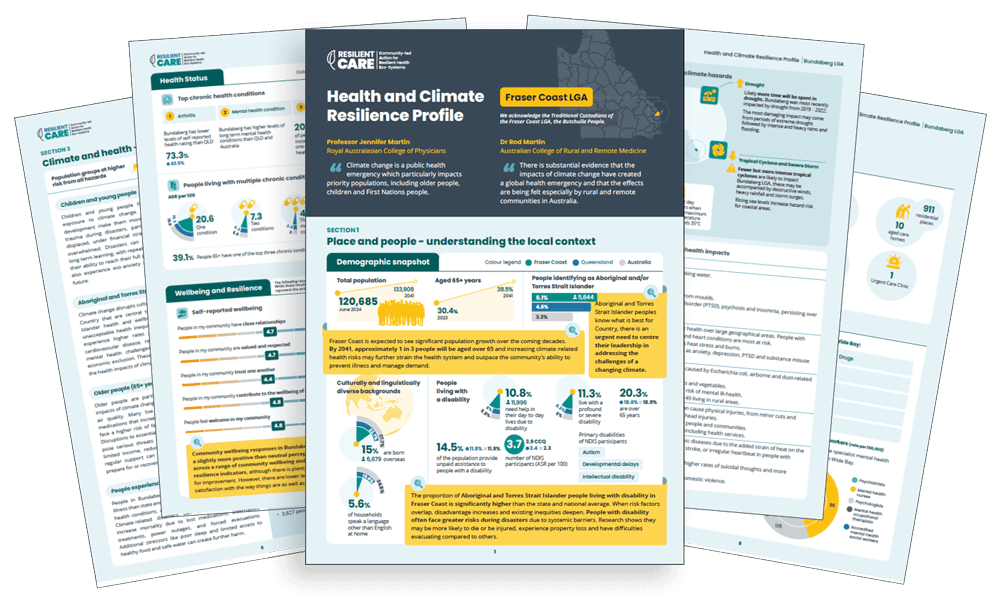
Caption: The Resilient CARE profiles combine climate projections, health data and local knowledge to show how heat, floods and extreme weather affect community health and wellbeing, and to identify who faces the greatest risk.
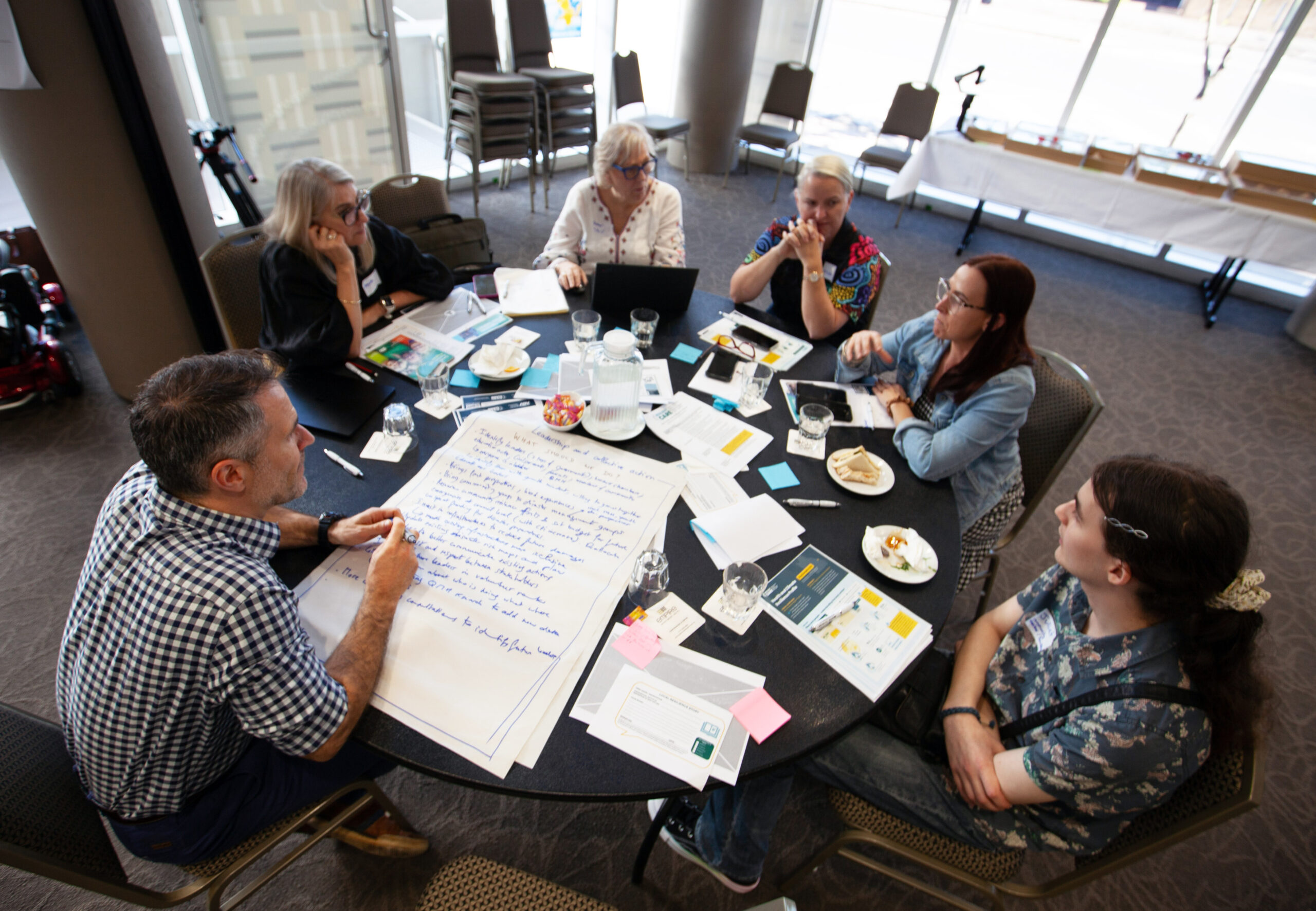
Caption: Valuable local Rockhampton insights were collected during region wide consultation bringing together climate and health data with community knowledge to reveal how risks and resilience intersect.
While the Australian Government Department of Health has contributed to the funding of this website, the information on this website does not necessarily reflect the views of the Australian Government and is not advice that is provided, or information that is endorsed, by the Australian Government.
The Australian Government is not responsible in negligence or otherwise for any injury, loss or damage however arising from the use of or the reliance on the information provided on this website.