Mental health and AOD service reform
Enhancing services to address community needs in Mental Health, Substance Use, and Suicide Prevention
Country to Coast, QLD has been working closely with local health partners, community members and health care providers to design a new model of service delivery for primary care mental health and wellbeing services.
Our vision is to establish a person-centered system, where every individual in the region, particularly those with the most significant needs, can access timely, appropriate care and have a voice in determining the types of services available.
The case for change
Our investment in mental health, alcohol and other drugs, and suicide prevention services has been increasing year on year, though health needs data indicates that our communities still face significant issues.
Across our region, rates of mental health, suicide and substance use disorders are higher than the state and national average, with extensive impacts on families and carers, and our healthcare services.
- In the past six years, though total funding has increased 24% from 2017/2018 to 2023/2024, the prevalence of mental and behavioural conditions is notably higher in our region (23,056 per 100,000) compared to Australian averages (20,084 per 100,000).
- Our regional population has higher rates of alcohol consumption and related hospitalisations, coupled with significantly higher hospitalisation rates for intentional self-harm, than state and national averages.
- Rates of illicit drug use are significant.
Central Queensland, Wide Bay, and Sunshine Coast regions also face unique challenges in addressing mental health, suicide and substance use disorders, due to geographical diversity, demographic composition, industry variations, and healthcare system dynamics.
- The broad regional footprint can make it difficult to access services, especially in remote and rural areas.
- Our priority populations of First Nations communities and youth require tailored approaches to service delivery.
- Varied industries across our region, including mining, agriculture, and tourism, influence the mental health and wellbeing of the workforce and communities that support them.
- Differences in income and socio-economic status can affect access to healthcare.
These factors are driving our reform efforts to boost early intervention and prevention pathways and ensure community-based treatment services respond to local needs.
Building Together
Responding to the challenges of our region requires us to think differently about the types of services we need and how they are delivered. Through our mental health services reform process, we have worked closely with health providers and community members, including people with lived experience, to identify issues with current services and how people can more easily access the support they need.
Project stages
Understanding local needs | June – July 2023
We reviewed current MHAOD programs we funded in the region and relevant datasets to understand key gaps or shortcomings in current mental health outcomes in CCQ’s region. We summarised our findings in Improving Mental Health – The Case For Change report.
Identifying models of care | July – October 2023
We reviewed how other health agencies delivered MHAOD programs and identified best practice system principles, approaches, and service models of care. We summarised this in our Mental Health Reform Opportunities Research Report. These steps helped us identify our consultation topics for the next stage and ensure an evidence-based approach.
Community consultation | November – January 2024
We met with community representatives across the region, including people with lived experience, through seven in-person workshops and three special interest groups, to receive feedback on the topics and issues identified in the Mental Health Reform Opportunities Research Report. This stage was finalised in January 2024 in our Community Consultation Report and Aboriginal and Torres Strait Islander Roundtable Consultation Summary Report which summarises the workshop findings and opportunities to be taken forward.
Validation of findings | February 2024
We held feedback and validation sessions to present a summary of findings from the research review and consultation sessions and to refine and prioritise the reform strategies.
Solution design | February 2024
In this final consultation stage and report, interested organisations and service users were invited to co-create and refine service delivery approaches that are effective and meaningful to each of the Sunshine Coast, Wide Bay and Central Queensland regions. The outcomes of these sessions shaped our general commissioning approach, ensuring that it resonated with community needs.
Commissioning services | April 2024
We released a request for proposals to identify models of care and innovative approaches to establishing the MHAODSP reform. Following a competitive tender process, community-based health and support services provider EACH was engaged to lead a consortium model with eight other organisations and deliver an integrated, region–wide model of service with consistent operational guidelines. EACH will bring the experience and expertise of its consortium members to enhance access and service availability.
Transitioning services to Better Connect | July to October 2024
EACH is leading a consortium of nine service providers, known as Better Connect, to enhance person-centred care and improve access to mental health support. Better Connect has established four MHAODSP Hub sites in Gympie, Hervey Bay, Rockhampton, and Emerald, operational from 1 October 2024. EACH will also coordinate 16 additional Spoke sites across the region to ensure comprehensive service availability.
Learn more about Better Connect (webinars)
Learn more about Better Connect. View the webinars below where EACH outlines services the Hubs and Spokes offer, explains how to access services as a referrer or community member and introduces the Better Connect service providers.
Evaluation of services | November 2024
We have engaged an experienced and independent external evaluator to conduct a comprehensive review of the MHAODSP reform process and to provide an impartial and thorough assessment of the reform’s effectiveness. This evaluation will inform future initiatives, guiding the ongoing refinement of services to ensure they are innovative, effective, and centered around community needs.
Networked services
From 1 October 2024, a new networked model for MHAODSP services funded by Country to Coast, QLD, is operating across the Central Queensland, Wide Bay, and the Sunshine Coast.
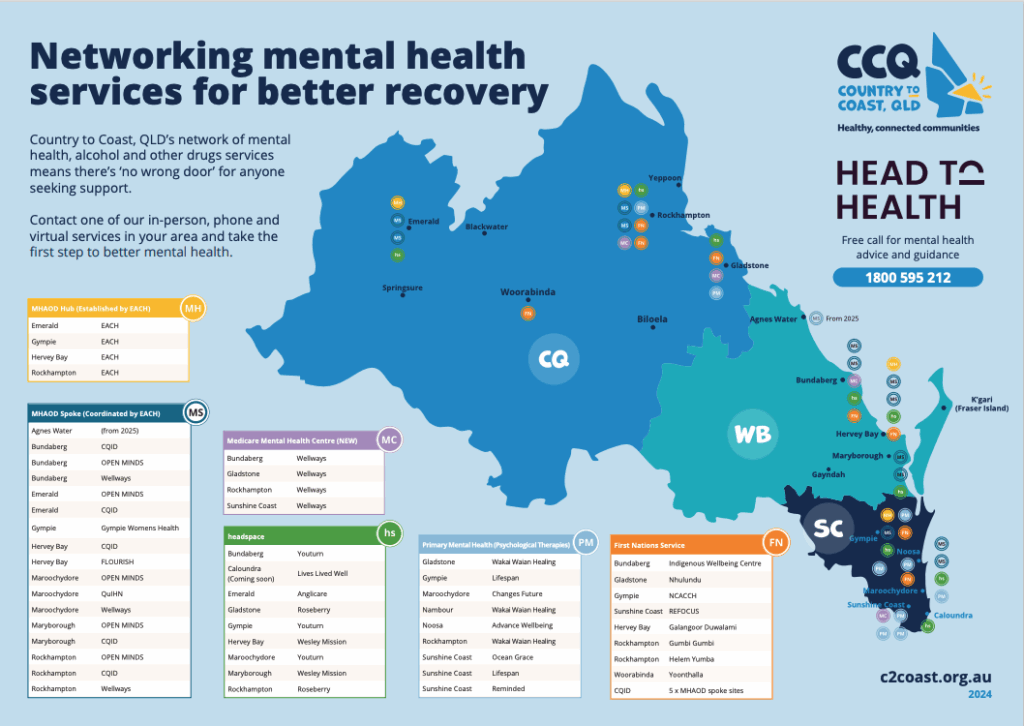
With the inclusion of the 4 MHAOD Hubs and 16 Spoke sites coordinated by EACH, there are 50 service points across the region, including the four adult Medicare Mental Health Centres operated by Wellways, eight headspace centres, dedicated First Nations services, and the centralised Medicare Mental Health phone support service.
Anyone seeking mental health support can freecall Medicare Mental Health on 1800 595 212 number or visit one of the in-person sites for advice and assistance in finding the most appropriate care pathway for their needs.
This new networked service model addresses community feedback about the complexity of navigating the historically fragmented mental health system by introducing a ‘no wrong door’ approach. Regardless of where they begin their help-seeking journey, residents can access free assessments, advice, and referrals to free or low-cost services.
Download Country to Coast, QLD’s MHAODSP Networked Services Map.
Reform Objects
Our goal with this reform is to make real, lasting changes in the way we approach mental health and substance use in our community. Here’s what we’re working towards:
Address social determinants
Approach
Consider the underlying factors like housing, employment, and social connections that impact mental health.
Strategies for Achievement
- Collaborate with non-health sector stakeholders
- Implement community development projects
Enhance serivce integration
Approach
Ensure seamless collaboration between various mental health, suicide prevention, and substance use services.
Strategies for Achievement
- Develop integrated care pathways
- Facilitate cross-sector partnerships and data sharing agreements
Improve accessibility and affordability
Approach
Make mental health, suicide prevention, and AOD services more accessible and affordable in the community.
Strategies for Achievement
- Expand community-based services
- Implement subsidised or free services for those in need
Rause quality & safety
Approach
Improve the quality, safety, and capacity of mental health and suicide prevention services.
Strategies for Achievement
- Adopt evidence-based practices
- Train communities and the workforce in quality and safe practices
Ensure timely and appropriate care
Approach
Ensure individuals receive the right care at the right time and in the right place.
Strategies for Achievement
- Develop a stepped care model
- Increase outreach and early intervention and prevention programs
Support recovery from substance use
Approach
Reduce the impact of substance use on individuals, families, and communities.
Strategies for Achievement
- Provide comprehensive recovery programs
- Support family and community education initiatives
Promote independence
Approach
Support independent living for people with severe mental illness.
Strategies for Achievement
- Purpose built psychosocial services
- Offer vocational training and employment support
Reduce suicide and self-harm
Approach
Implement regional services with a focus on growing the capability of the sector and community to recognise and respond to suicide risk.
Strategies for Achievement
- Enhance crisis intervention services
- Invest in post-intervention support programs
Build resilience and wellbeing
Approach
Improve individual and community resilience and overall wellbeing.
Strategies for Achievement
- Implement community wellbeing programs
- Promote mental health literacy and self-care practices
Focus on high risk groups
Approach
Target interventions towards groups at highest risk of suicidal behaviour.
Strategies for Achievement
- Develop targeted support services for high-risk groups
- Conduct community outreach and engagement initiatives
Foster collaboration and coordination
Approach
Enhance program and policy coordination through partnerships.
Strategies for Achievement
- Establish multi-sectoral oversight and accountability structures
- Coordinate or commission collaborative forums and workshops
Implement structural interventions
Approach
Conduct long-term structural changes in areas of greatest need.
Strategies for Achievement
- Advocate for policy changes
- Invest in infrastructure and resource development in underserved areas
FAQs
What happens if I previously relied on mental health services funded by CCQ, but these are now closed?
As part of the reform process, some previous providers were decommissioned. From July to October 2024, we worked closely with providers to ensure a smooth transition for any one receiving services or those who had just been referred. Clinical Care Navigators, appointed by EACH, supported providers and their clients to ensure uninterrupted access to care for anyone using services funded by Country to Coast, QLD.
If you would like further guidance about mental health support that’s right for you, contact Head to Health at 1800 595 212 and speak with one of the qualified mental health clinicians to find an appropriate support pathway.
How can I access services funded by CCQ?
Our Head to Health phone support service is the primary point of contact for all mental health support services funded by Country to Coast, QLD. Whether you’re a community member or a service provider, you can freecall Head to Health on 1800 595 212. If you are seeking mental health support, a qualified mental health intake officer will guide you to the most suitable local service for your needs.
What measures will CCQ undertake to ensure current services remain adaptable to evolving community needs?
CCQ is committed to an iterative approach in enhancing services within its regions. We anticipate ongoing improvements and pledge to collaborate with our communities in the years ahead to develop location-specific services.